
AI upgrades emergency fleets as Sweden targets faster response
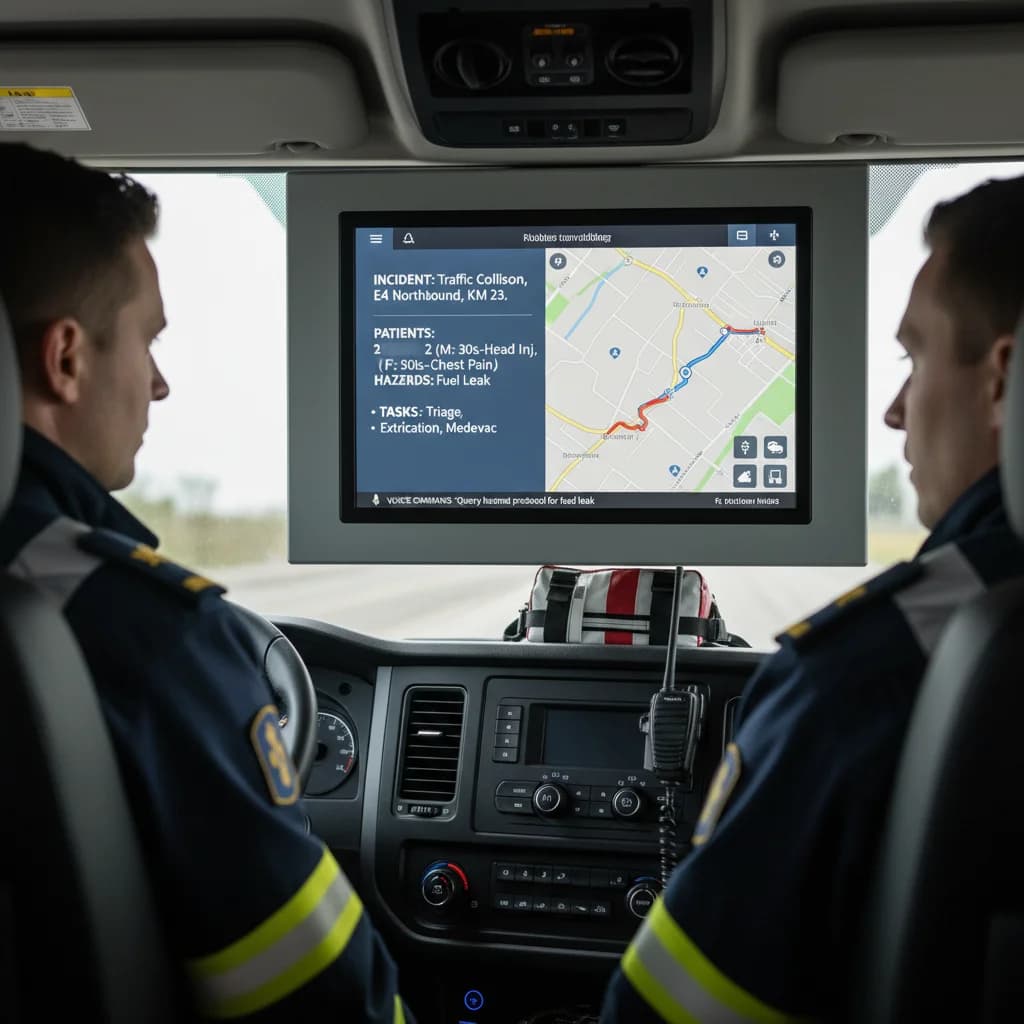
A Swedish startup is deploying AI inside emergency vehicles to replace older onboard systems and improve how crews receive, interpret, and act on operational information. The move reflects a broader shift in public-safety technology: bringing modern machine learning and real-time data fusion into fleets that still rely on fragmented, legacy software.
From “old systems” to AI-assisted operations
Many emergency fleets run a patchwork of tools: separate terminals for dispatch messages, navigation, incident reporting, and vehicle telemetry. These setups often depend on outdated user interfaces, limited integration, and manual workflows. An AI layer can unify these streams, summarizing incoming incident details, prioritizing tasks, and presenting the most relevant context to responders without forcing them to navigate multiple screens.
In practice, AI in a blue-light vehicle typically aims to:
- Reduce cognitive load by turning long dispatch notes into concise, actionable summaries
- Improve situational awareness by correlating location, traffic, weather, and incident history
- Speed up reporting by converting speech or structured prompts into standardized documentation
- Flag safety-relevant information such as hazardous materials, prior call patterns, or access constraints
What AI can realistically do inside a moving vehicle
The most valuable in-vehicle AI features are usually narrow, reliability-focused, and designed around human decision-making rather than replacing it. For emergency services, the technical challenge is not only model accuracy but also predictability, latency, and resilience in the field.
Common capability areas include:
- Natural language processing for dispatch messages: extracting key entities like address, patient age, symptoms, hazards, and caller notes
- Voice interfaces for hands-free interaction: allowing crews to query protocols, request route changes, or draft reports
- Decision support: suggesting checklists, triage prompts, or equipment reminders based on incident type
- Routing optimization: combining live traffic, road closures, and priority driving rules to propose safer, faster routes
Because connectivity can be inconsistent, many deployments lean toward edge computing: running parts of the system locally in the vehicle, with cloud synchronization when available. That architecture reduces dependence on mobile networks and supports faster response times.
Data, governance, and the privacy bar for public safety AI
Emergency services handle sensitive personal data, which raises the compliance bar for any AI vendor. In Sweden and across the EU, systems must align with GDPR requirements, including data minimization, purpose limitation, and strong access controls. If the AI processes patient information or criminal justice data, procurement teams typically demand clear documentation on data retention, encryption, audit logging, and where inference and storage occur.
The EU AI Act also matters. While the law’s final operational details will roll out over time, public-sector uses tied to safety and essential services are likely to face heightened scrutiny. Vendors that can demonstrate robust risk management, human oversight, and traceability will be better positioned as agencies standardize procurement criteria.
Why legacy replacement is hard—and why it’s happening now
Replacing “old systems” in emergency fleets is notoriously difficult because reliability is non-negotiable and integrations are complex. Dispatch centers, radio networks, mapping providers, and case-management platforms often come from different vendors with long contract cycles. Yet modernization pressure is rising for several reasons:
- Expectations for digital workflows: responders increasingly need real-time data, not static messages
- Rising incident complexity: climate-related events and urban congestion increase the value of predictive routing and resource planning
- Workforce constraints: AI-assisted documentation and triage support can reduce administrative burden
- Security requirements: older in-vehicle terminals may lack modern patching and hardening practices
At the same time, AI tooling has matured. Modern transformer-based language models can summarize and extract information from text with higher accuracy than earlier rule-based systems. Meanwhile, edge hardware has improved, with more capable CPUs and GPUs available in compact, ruggedized form factors.
Competitive landscape: from LLMs to fleet platforms
AI for emergency services sits at the intersection of several markets: computer-aided dispatch, telematics, digital evidence management, and clinical documentation. Large platform vendors can bundle capabilities, while startups often differentiate through faster iteration, better user experience, or specialized models trained for emergency terminology.
The AI stack typically combines:
- A language model for summarization and structured extraction
- A mapping and routing engine with real-time updates
- Integration middleware to connect dispatch systems and vehicle sensors
- A security layer for identity, logging, and policy enforcement
Some vendors will rely on general-purpose models from major providers, while others will develop domain-tuned models to reduce hallucinations and improve consistency. In high-stakes settings, agencies often prefer constrained outputs, templates, and verification steps over open-ended generation.
What to watch next
If the Swedish startup’s rollout expands, the key indicators will be operational rather than marketing-driven: measurable reductions in time-to-read dispatch information, faster report completion, fewer navigation errors, and improved adherence to protocols. Procurement outcomes will also signal market readiness—especially whether agencies require on-prem or EU-hosted deployments, strict data boundaries, and independent security reviews.
The broader implication is clear: AI is moving from back-office analytics into the vehicle itself. For emergency services, that shift could translate into faster decisions and safer operations—provided the technology is engineered for reliability, privacy, and human control.
Related Articles
SL Live Map turns Stockholm transit data into a real-time obsession
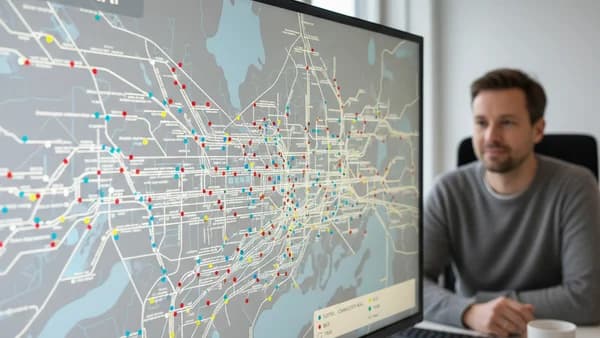
A Swedish developer has built a real-time “live map” of Stockholm’s public transport that lets users watch metro trains, commuter rail and buses move across the city. The project, called SL Live Map, pulls open transit data via Trafiklab.se and has drawn reactions ranging from train operators’ praise to users saying they watch it for hours—part utility, part digital mindfulness.
A Swedish developer has built a real-time “live map” of Stockholm’s public transport that lets users watch metro trains, commuter rail and buses move across the city. The project, called SL Live Map,...

Meta’s Nvidia Chip Buying Spree Signals a New AI Arms Race
Meta Platforms is preparing to deploy millions of Nvidia chips across its AI data centers, including standalone Grace CPUs and next-generation Vera Rubin systems. The plan, described by CEO Mark Zuckerberg as a push to deliver “personal superintelligence” globally, could channel a large share of Meta’s projected AI investment—up to $135 billion by 2026—toward Nvidia.
Meta Platforms is preparing to deploy millions of Nvidia chips across its AI data centers, including standalone Grace CPUs and next-generation Vera Rubin systems. The plan, described by CEO Mark Zuckerberg as a...

Mistral’s €1.2B Sweden Data Center Signals Europe’s AI Compute Push
French AI company Mistral plans to invest €1.2 billion to build a 23-megawatt data center in Borlänge, Sweden, together with Sweden’s EcoDataCenter, owned by real estate firm Areim. CEO and co-founder Arthur Mensch says the site will support Mistral’s AI models and its cloud service, and marks the start of a broader Nordic expansion.
French AI company Mistral plans to invest €1.2 billion to build a 23-megawatt data center in Borlänge, Sweden, together with Sweden’s EcoDataCenter, owned by real estate firm Areim. CEO and co-founder Arthur Mensch...

French prosecutors raid X as Grok faces widening probes
Paris prosecutors, backed by France’s national cyber unit and Europol, searched X’s French offices on Tuesday as an investigation launched in January 2025 broadened from alleged algorithmic bias to the company’s Grok chatbot. Authorities are examining claims that Grok generated Holocaust-denial content—illegal in France—and that it can produce sexualized AI images, including of children.
Paris prosecutors, backed by France’s national cyber unit and Europol, searched X’s French offices on Tuesday as an investigation launched in January 2025 broadened from alleged algorithmic bias to the company’s Grok chatbot....