

France expands X investigation to Grok amid EU scrutiny
Paris prosecutors, backed by France’s national cyber unit and Europol, searched X’s French offices on Tuesday as an investigation launched in January 2025 broadened from alleged algorithmic bias to the company’s Grok chatbot. Authorities are examining claims that Grok generated Holocaust-denial content—illegal in France—and that it can produce sexualized AI images, including of children.
What French authorities are investigating at X
The Paris prosecutor’s office said the search was part of the ongoing inquiry opened earlier this year. The case reportedly began with concerns about how X’s recommendation and ranking systems may distort information flows. It later expanded to include Grok, the generative AI assistant integrated into X and positioned as a real-time, social-data-connected chatbot.
The reported focus areas now include:
- Alleged production or amplification of Holocaust denial content, which can trigger criminal liability under French law.
- The ability to generate sexualized synthetic imagery, including content involving minors—an area where many jurisdictions treat both generation and distribution as severe offenses.
- Potential platform-level responsibilities, spanning moderation, safety controls, and the design choices that shape what users can generate and share.
X had not publicly commented on Tuesday’s search at the time of reporting. Elon Musk previously rejected earlier accusations and described the French investigation as politically motivated.
Why Grok changes the legal and technical stakes
A probe into “biased algorithms” is already complex, but adding a generative model materially raises the stakes. Traditional ranking systems decide what to show; generative systems can create new content on demand. That shifts risk from distribution to production.
For AI companies, the hard problem is that modern large language models and multimodal generators can be steered into producing harmful outputs even when safeguards exist. Safety mitigations typically combine:
- Training-time alignment (fine-tuning, reinforcement learning from human feedback)
- Inference-time guardrails (policy filters, refusal behaviors)
- Content classifiers for text and images
- Rate limits, friction, and user reporting pathways
Regulators increasingly test whether these controls are effective in practice, not just documented in policy. Allegations involving Holocaust denial and child sexual content are especially sensitive because they intersect with criminal statutes and strict obligations for platforms to prevent dissemination.
Mandatory summons and cross-border enforcement questions
French authorities reportedly summoned Elon Musk and former X CEO Linda Yaccarino for questioning on April 20, alongside other employees called as witnesses. While such summons can be mandatory under French procedure, enforcing attendance can be more difficult when individuals reside outside France.
This highlights a recurring issue in AI governance: models and platforms are global, but enforcement is national or regional. Investigations often require cooperation across borders for evidence collection, interviews, and access to technical documentation. Europol’s involvement signals that authorities may be treating the case as one with broader European relevance, particularly if content or operational decisions span multiple jurisdictions.
The UK opens its own Grok investigation
On the same day, the UK’s Information Commissioner’s Office (ICO) said it opened a formal investigation into Grok. The ICO is examining how the chatbot processes personal data and its ability to generate harmful sexualized images and videos.
That combination—privacy plus safety—reflects how generative AI systems can create risk on multiple fronts:
- Personal data: training data provenance, user prompts, and model outputs that may reveal or infer sensitive information
- Deepfake and synthetic media harms: non-consensual sexual imagery, impersonation, and the creation of illegal content
- Platform integration: when a chatbot is embedded into a social network, outputs can spread rapidly and be contextually targeted
The UK inquiry also underscores that AI oversight is not limited to dedicated “AI regulators.” Data protection authorities are using existing legal frameworks to scrutinize model development and deployment.
What this means for AI platforms and the broader ecosystem
The French and UK actions fit a larger trend: regulators are moving from principles to enforcement, especially where generative AI intersects with elections, hate speech, child safety, and biometric or sexual content.
For companies building or deploying models—whether X, OpenAI, Anthropic, Google, or smaller startups—the operational takeaway is that “safety by design” is becoming a compliance requirement. That typically means:
- Documented risk assessments and red-teaming results
- Stronger age-gating and identity friction for high-risk features
- Clear audit trails for model changes and safety patches
- Rapid incident response processes tied to legal obligations
If authorities conclude that safeguards were inadequate, consequences could extend beyond fines to product restrictions, mandated changes to model behavior, or increased oversight of how models are trained and integrated into consumer platforms.
As generative AI becomes more multimodal and more tightly embedded into social networks, investigations like these are likely to set precedents for how Europe defines platform responsibility when a chatbot can both generate and amplify illegal content.
Related Articles

SL Live Map turns Stockholm transit data into a real-time obsession
A Swedish developer has built a real-time “live map” of Stockholm’s public transport that lets users watch metro trains, commuter rail and buses move across the city. The project, called SL Live Map, pulls open transit data via Trafiklab.se and has drawn reactions ranging from train operators’ praise to users saying they watch it for hours—part utility, part digital mindfulness.
A Swedish developer has built a real-time “live map” of Stockholm’s public transport that lets users watch metro trains, commuter rail and buses move across the city. The project, called SL Live Map,...

Meta’s Nvidia Chip Buying Spree Signals a New AI Arms Race
Meta Platforms is preparing to deploy millions of Nvidia chips across its AI data centers, including standalone Grace CPUs and next-generation Vera Rubin systems. The plan, described by CEO Mark Zuckerberg as a push to deliver “personal superintelligence” globally, could channel a large share of Meta’s projected AI investment—up to $135 billion by 2026—toward Nvidia.
Meta Platforms is preparing to deploy millions of Nvidia chips across its AI data centers, including standalone Grace CPUs and next-generation Vera Rubin systems. The plan, described by CEO Mark Zuckerberg as a...

Mistral’s €1.2B Sweden Data Center Signals Europe’s AI Compute Push
French AI company Mistral plans to invest €1.2 billion to build a 23-megawatt data center in Borlänge, Sweden, together with Sweden’s EcoDataCenter, owned by real estate firm Areim. CEO and co-founder Arthur Mensch says the site will support Mistral’s AI models and its cloud service, and marks the start of a broader Nordic expansion.
French AI company Mistral plans to invest €1.2 billion to build a 23-megawatt data center in Borlänge, Sweden, together with Sweden’s EcoDataCenter, owned by real estate firm Areim. CEO and co-founder Arthur Mensch...
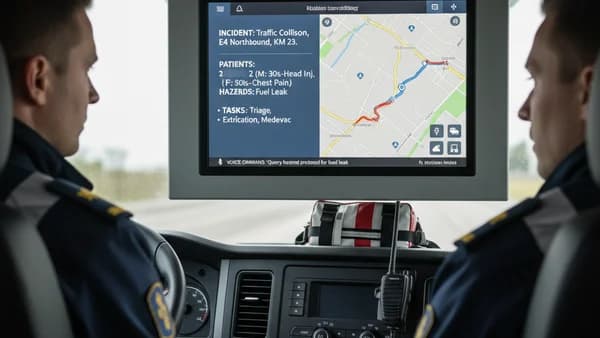
Swedish startup brings AI to emergency vehicles, replacing legacy systems
A Swedish startup is deploying AI inside emergency vehicles to replace older onboard systems and improve how crews receive, interpret, and act on operational information. The move reflects a broader shift in public-safety technology: bringing modern machine learning and real-time data fusion into fleets that still rely on fragmented, legacy software.
A Swedish startup is deploying AI inside emergency vehicles to replace older onboard systems and improve how crews receive, interpret, and act on operational information. The move reflects a broader shift in public-safety...