
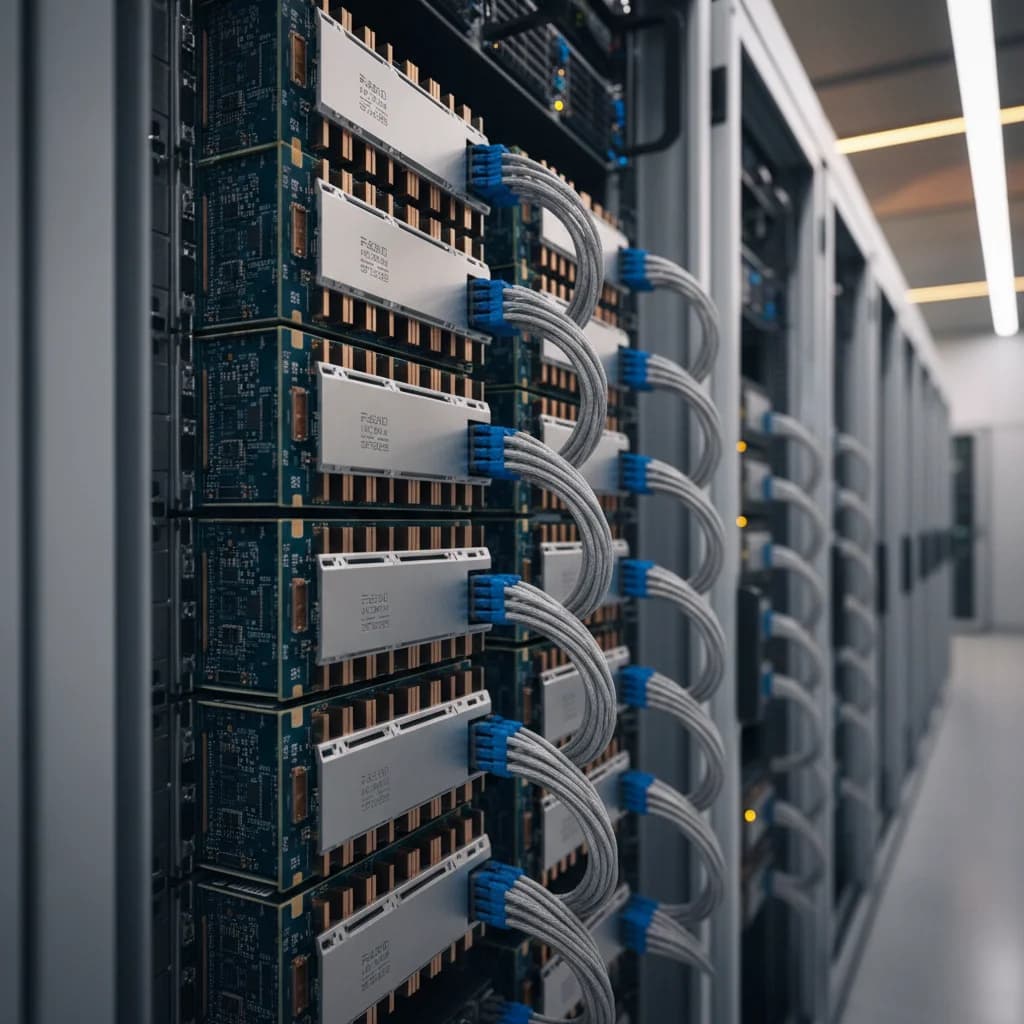
Nvidia targets February deliveries of advanced AI chips to China
Nvidia has told Chinese customers it aims to begin delivering its second-most powerful AI chips to China before the Lunar New Year in mid-February, according to Reuters sources. Initial shipments would come from existing inventory, but the plan remains uncertain because Chinese authorities have not approved purchases of H200 chips for domestic companies.
What Nvidia is planning to ship, and in what volumes
People familiar with the discussions said the first deliveries would total roughly 5,000 to 10,000 chip modules, equivalent to about 40,000 to 80,000 H200 chips. The use of existing stock suggests Nvidia is trying to meet near-term demand without waiting for new production runs.
The same sources indicated Nvidia is also considering expanding production capacity, with new orders potentially available from the second quarter of 2026. That timeline underscores how constrained leading-edge AI accelerator supply remains, even as the market has moved from experimental generative AI deployments to large-scale inference and training clusters.
Regulatory uncertainty: approvals in China and controls in the US
A central risk is that Beijing has not yet approved any H200 purchases for Chinese firms. Even if Nvidia can physically ship product, enterprise-scale deployments typically depend on clear procurement pathways, financing, and regulatory sign-off. Delays can push customers toward alternatives or reduce near-term deployment ambitions.
On the US side, advanced AI chips sit at the center of export-control policy designed to limit China’s access to high-end computing for military and strategic applications. Over the past two years, US rules have increasingly targeted performance thresholds tied to interconnect bandwidth, compute density, and data center scalability—precisely the attributes that make chips like the H200 valuable for training and running large language models.
For Nvidia, the operational challenge is not only compliance but predictability. Frequent rule updates can force rapid product segmentation, redesigns, or region-specific SKUs, complicating manufacturing plans and customer roadmaps.
Why the H200 matters in today’s AI stack
The H200 is positioned as a high-end data center GPU optimized for modern AI workloads, where memory capacity and bandwidth are often as important as raw compute. Large language models and multimodal systems can be bottlenecked by how quickly parameters, activations, and attention caches move through memory, especially during training and high-throughput inference.
In practical terms, customers buy top-tier accelerators to: - Train larger frontier and near-frontier models faster - Serve more concurrent inference requests with lower latency - Reduce the number of GPUs needed for a given workload by fitting larger batches or contexts in memory - Improve utilization in distributed training through faster data movement
If Chinese customers can access H200-class performance, it could accelerate domestic model development and deployment across sectors such as e-commerce, advertising, robotics, and industrial automation.
Competitive and ecosystem implications
Nvidia remains the default platform for many AI developers because of its CUDA software ecosystem, mature tooling, and broad support across frameworks. That makes any shipment of advanced Nvidia accelerators strategically meaningful, even if volumes are limited.
At the same time, constraints on supply or approvals can create openings for alternatives: - Domestic Chinese GPU and accelerator vendors may gain share if they can meet performance-per-watt and software-compatibility needs. - Cloud providers may shift capacity planning toward inference-optimized setups, using a mix of accelerators and custom silicon where available. - Model developers may optimize architectures, quantization, and serving stacks to reduce dependency on the most advanced chips.
The reported shipment range—tens of thousands of H200-equivalent chips—would be significant for near-term deployments but still small relative to global hyperscaler buildouts. That means the biggest impact may be on specific large customers and strategic projects rather than the entire market.
What to watch next
The next few weeks will likely determine whether Nvidia’s plan becomes a real delivery wave or remains a tentative schedule. Key indicators include: - Whether Chinese authorities approve H200 purchases for domestic firms - Any new US export-control updates that further restrict performance or interconnect capabilities - Signals from Nvidia and major cloud or enterprise buyers about 2025–2026 capacity planning
If approvals proceed and shipments start from inventory as described, it would show that demand for top-tier AI compute in China remains strong and that supply chains are adapting to a more fragmented, policy-driven global AI hardware market.
Related Articles

New Attack Method: How ChatGPT Can Trick Users Into Installing Malware
A new social-engineering technique is emerging: attackers can use ChatGPT-style conversations to persuade people to install malware by following seemingly helpful, step-by-step instructions. The risk is not that the model “hacks” a device directly, but that convincing dialogue lowers user skepticism at the exact moment a malicious download or command is presented.
A new social-engineering technique is emerging: attackers can use ChatGPT-style conversations to persuade people to install malware by following seemingly helpful, step-by-step instructions. The risk is not that the model “hacks” a device...