
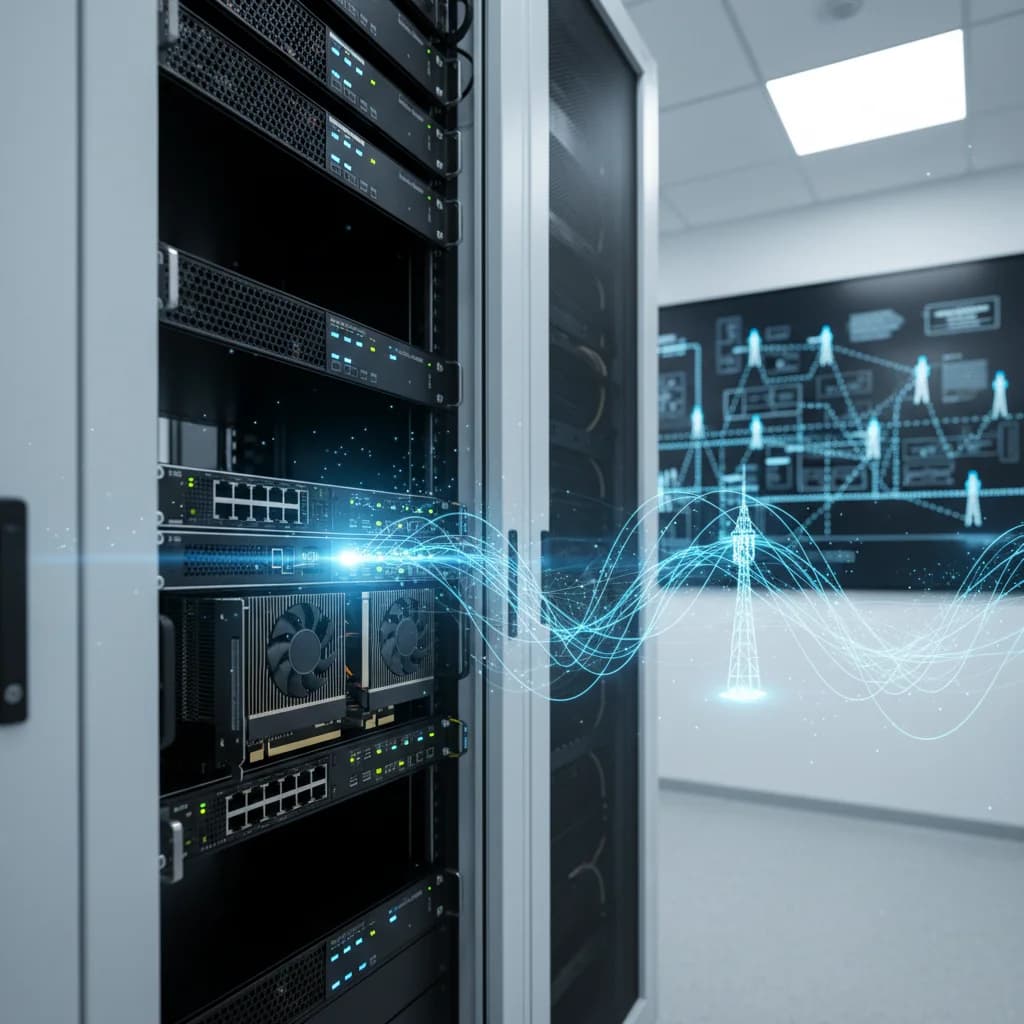
How AI Could Automate Mobile Networks With NVIDIA Support
AI is increasingly being positioned as the control layer for mobile networks, and a Swedish report highlights an ambitious vision: using AI to adapt and optimize cellular infrastructure with support from NVIDIA’s compute stack. The pitch is straightforward—make networks more autonomous, more efficient, and faster to troubleshoot as traffic patterns and service demands change.
What “AI-adapting the mobile network” typically means
In telecom, “AI adaptation” is rarely a single feature. It usually refers to a collection of automation capabilities across the radio access network (RAN), transport, and core network. Operators want systems that can sense conditions, predict issues, and act—without waiting for manual configuration.
Common targets for AI-driven optimization include:
- Traffic forecasting to anticipate congestion by location and time
- Dynamic resource allocation, such as tuning spectrum use or scheduling parameters
- Energy savings through intelligent sleep modes and cell on/off strategies
- Fault prediction and root-cause analysis to reduce outages and truck rolls
- Quality-of-service optimization for latency-sensitive apps (gaming, AR, industrial IoT)
The industry term for this direction is “autonomous networks,” often aligned with standards and initiatives such as O-RAN’s RAN Intelligent Controller (RIC), which splits control into near-real-time and non-real-time functions. AI models can be deployed as apps that recommend or execute policy changes, provided guardrails are in place.
Why NVIDIA is relevant to telecom AI right now
NVIDIA’s role in telecom has expanded beyond being a GPU vendor. Its platforms support accelerated computing for AI training and inference, and it has pushed deeper into networking through technologies such as high-performance interconnects and data processing approaches that offload work from CPUs.
For mobile networks, NVIDIA’s value proposition generally maps to two needs: 1) Running AI inference close to where decisions are made, including at the edge 2) Training and updating models on large datasets from network telemetry
Telecom networks generate massive volumes of time-series data: counters, logs, traces, and radio measurements. Turning that into real-time decisions can be compute-intensive, especially when models must react quickly and safely. GPU acceleration can help when operators deploy more sophisticated models, run many parallel analyses, or consolidate workloads.
The business case: automation, cost pressure, and complexity
Mobile operators face a difficult equation: traffic grows, customer expectations rise, and margins remain tight. Meanwhile, networks are becoming more complex due to 5G standalone cores, network slicing, private 5G deployments, and densification.
AI-driven automation is attractive because it targets several cost centers at once:
- Reduced operational expenditure through fewer manual interventions
- Higher utilization of existing spectrum and infrastructure
- Faster incident response and improved service reliability
- Lower energy consumption, a major and rising line item
If AI can prevent even a small fraction of outages or reduce energy use across thousands of sites, the savings can be material. But telecom is also conservative for good reasons: changes to network parameters can degrade service quickly if models behave unexpectedly.
Technical hurdles: data quality, safety, and integration
The gap between a compelling demo and production deployment is large. AI systems in telecom must deal with noisy telemetry, inconsistent vendor data formats, and shifting network conditions.
Key challenges include:
- Data governance: ensuring telemetry is accurate, labeled, and retained appropriately
- Model drift: traffic patterns change with seasons, events, and new device behavior
- Closed-loop control risk: automated actions can cause instability if feedback loops are not carefully designed
- Multi-vendor environments: integrating AI across equipment from different suppliers
- Latency constraints: some decisions must happen in milliseconds
Many operators therefore start with “human-in-the-loop” systems that recommend actions, then gradually move to partial automation with strict policy constraints and rollback mechanisms.
How this fits with broader AI and regulation trends
Telecom AI sits at the intersection of critical infrastructure and advanced automation. In Europe, regulatory expectations around resilience, cybersecurity, and responsible AI are rising. Even when a telecom use case is not directly consumer-facing, operators must demonstrate control, auditability, and security.
Practically, that means:
- Clear accountability for automated decisions
- Monitoring and logging for post-incident analysis
- Strong security for model supply chains and update pipelines
- Robust testing before enabling closed-loop automation
At the same time, the AI ecosystem is shifting toward smaller, more efficient models and better on-device/edge inference. That trend benefits telecom, where deploying massive models everywhere is impractical. Expect more emphasis on specialized models, hybrid approaches combining rules and ML, and edge-friendly inference optimized for performance per watt.
What to watch next
The most meaningful signals will be operational, not promotional. Look for:
- Trials that show measurable reductions in energy use or outage duration
- Deployment in near-real-time RAN control with clear safety constraints
- Evidence that AI works across multi-vendor networks, not just single-stack demos
- A roadmap for continuous model updates without service risk
If the vision succeeds, AI could become a standard layer in network operations—turning cellular infrastructure into a more adaptive system that tunes itself in response to demand. NVIDIA’s compute ecosystem may accelerate that shift, but the winners will be the operators and vendors that can prove reliability, security, and real-world ROI.
Related Articles

Swedish towns face exam crunch as AI drives return to proctored tests
Distance students in Sweden are increasingly being pushed back into supervised exam halls as universities tighten rules to curb AI-assisted cheating. An SVT review highlights how gaps in local exam provision force students to travel long distances and pay fees—an issue now drawing attention in Växjö and Kalmar as demand for proctored sittings rises.
Distance students in Sweden are increasingly being pushed back into supervised exam halls as universities tighten rules to curb AI-assisted cheating. An SVT review highlights how gaps in local exam provision force students...
AI in Targeting: What the Claude Claims Signal for Modern Warfare
Early on February 28, reports said the United States and Israel launched a joint attack on Iran, carrying out nearly 900 missile strikes in the first 12 hours.
Early on February 28, reports said the United States and Israel launched a joint attack on Iran, carrying out nearly 900 missile strikes in the first 12 hours....

AI Experts: Which Industries Will Change First
Fears that AI will simply replace workers are overstated, according to AI transformation researcher Einav Peretz Andersson at Jönköping University. Instead, she argues, roles will evolve as AI improves productivity and quality. The biggest shift comes from agentic AI, systems that can act toward goals rather than only answer questions.
Fears that AI will simply replace workers are overstated, according to AI transformation researcher Einav Peretz Andersson at Jönköping University. Instead, she argues, roles will evolve as AI improves productivity and quality.

Anthropic resists Pentagon push for unrestricted Claude access
Anthropic CEO Dario Amodei said Thursday the company cannot “in good conscience” accept US government demands for unrestricted access to its AI systems, setting up a high-stakes clash between AI safety commitments and Washington’s push for faster military adoption.
Anthropic CEO Dario Amodei said Thursday the company cannot “in good conscience” accept US government demands for unrestricted access to its AI systems, setting up a high-stakes clash between AI safety commitments and...